
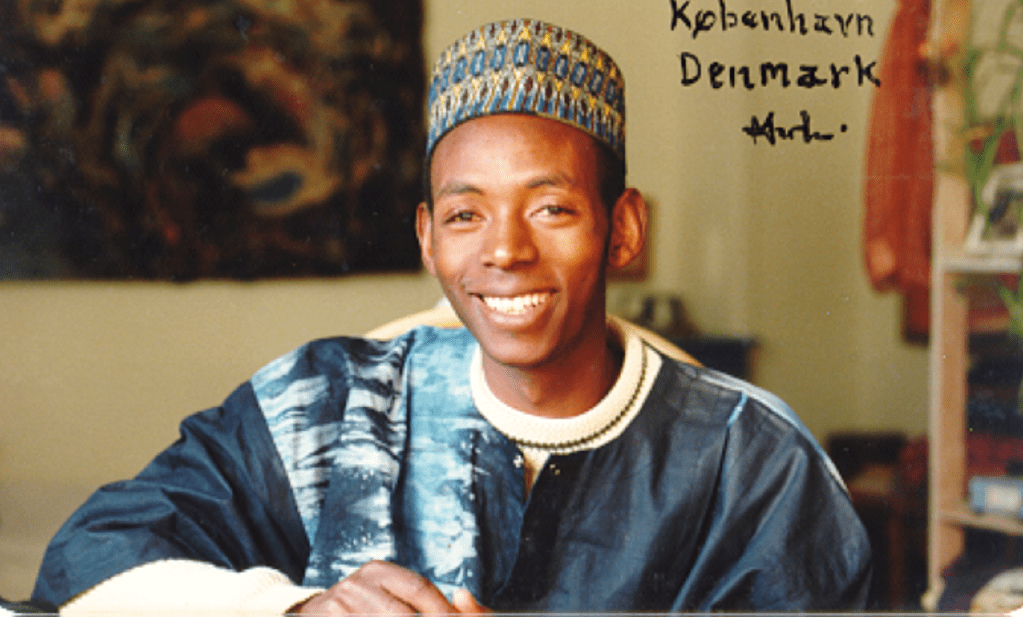
Keynote Address Presented on the Occasion of the Civic Reception ofMr. Manu Jaji Gidado, attaché at the Secretariat of the Presidency of the Republic at Sabga, 7th February, 1999.
I feel privileged to have been given the honour of assuming this political rostrum to examine with you the fine nuances and beauty of our identity and aspirations as a people. But before we settle to business let me first of all add my own modest jabbama and laaleeko to all of you here present today. The mere fact that so many have made the personal sacrifice to travel to this particular place cannot go unnoticed. Fulbe on jaarama!!!
A place which, is no mere coincidental physical spot. Sabga as we already know is the name of a man. The first Mbororo settler of this area! Who was this man? Where did he come from? Where was he going? Why did he choose to make Sabga a permanent home? Questions… This guy’s personal life story is also the history of a people. In other words why and how come is Sabga home to people who come from Ngaoundere, Maroua, Baffoussam, Douala, Yaounde, Bertoua not least Ngwo, you name the rest. All of us shall be leaving after this occasion to “go home”! Yet Sabga is home to all of us! To be able to understand this we must revisit the very history of the Mbororo community.
Very few authorities are agreed as to their place of origin. It is not necessary to drag you through all the different theories but one of these found amongst the people themselves gives an insight into our identity and aspirations as a people. This tells of a story of origin in Malle (most probably present day Republic of Mali). That the Mbororo are the offspring of a meeting between a girl called Bajamango from a settled community and a water spirit. The story goes that this girl went to a nearby pool to fetch water and was accosted by some extremely handsome gentleman who had come out of the pool. They had contacts and she conceived a child by him. She delivered a child who grew up to be different from the others both in physical features as well as attitudes. He never liked working on the farm and was spurned by his siblings. Unhappy about this he asked his mother to know why he is different from the rest. And the mother told him. One day after being insulted by the others as an illegitimate child he ran to the pool in tears. The man came out and asked the reason for his sorrow and promised to redress the situation. He asked the boy to fetch some wood and set a fire. When the boy complied, he then asked him to go in any direction he chose, but that he should not look back no matter what. The boy obeyed but as he traveled miles and miles away, he was puzzled by the fact that he could still hear the fire burning. It came to a point where he could no longer contain his curiosity and he turned. Trouping behind him where herds and herds of cattle coming out of the pool, their shiny horns knocking against each other. One bull (the most beautiful cow that ever was the Mbororo regrettably say!) had its head and front legs out of the water when the boy looked back and it fell back in to the pool. The father who had stood watching knew what had happened. With a sigh he said to himself:
My son, had you not looked back, none of your offspring will want but now that you have, you and your children and your children’s children will have to take good care of what you have got. Otherwise, some of you will one day not have any cattle to care for.
For us the Mbororo therefore, cattle herding is a way of life. Our identity and measure of self-worth, the meaning we find in our whole social existence—the very fabric of society. For generations we have wondered across states borders. The priority at all times and in all places has always been to preserve and protect our cattle herds. Thus the constant flight from all problems and outside influence. Over the years we have developed a culture of “otherness”. An aloofness that has more than meets the eye.
So why are we in Sabga today? Obviously, because Sawga like our mythic ancestor came here to search for greener pastures for our cattle. But why Sabga and not Ngwo (Jaji’s birth place and hometown). Almost a 100 years ago this place was the choice of an individual. A 100 years later the same place is today a collective choice. A conscious political choice of a people for an unusual event. A choice with a political consequence! And this brings us to the real issues of the day!
I cannot pretend to give lessons in politics to people who know better than me. But I do know my own little grain of sand to know that the basis of all genuine political participation is “choice”.
- The Head of state has chosen Mr. Manu Jaji Gidado for greater responsibilies;
- 2. The Mbororo Community has chosen to honour that choice by choosing Sabga asthe place to celebrate it.
- 3. And I am flattered that they have chosen me as the person to address that choice.
And we can go on and on and on!
Choice therefore, is both the subject as well as the reason for our coming together here today. We are here to celebrate a choice that affects us as a people—the Mbororo people. And whether we like it or not, whether we are politicians or development workers this in itself is a political choice. It is a celebration of the new visibility of an ethnic minority who has for too long been (at best) ignored. We have so far been represented, willy-nilly, in the politics of this country by one and the same self-imposed “king” to our community. And this individual above all else bears special, personal responsibility for turning the lives of the Mbororo people, particularly in the North West Province into a nightmare. But we do pray and hope that this man shall one day be brought to justice for his crimes against humanity. And we do not really demand anything more than to be recognised as human, as citizens of this country. We do not demand anything beyond our civic/civil rights. We do not demand anything more than to be known and understood in the context of our culture and lifestyle. We are not therefore, advocating a language of differentiation. We simply want to be us and to be accepted as such.
Here we are, at the end of a millennium – some things have to change. We do not have to convince anyone of that! The history of this century hurrying to an end is being rewritten so quickly that it is hard to understand either what happened just yesterday or just what is going on now. But for all its insecurities of the moment, it is a world of unprecedented possibilities. As individuals or as a collective we all have a stake in this future. It is our responsibility not only to convince each other that something can be done but also to set the agenda for the work awaiting us.
The President has made the first step for us by choosing one of us as touch bearer. Mr. Jaji and the Mbororo community have genuine reasons to celebrate. We hope to cease to be prey to political predators of the likes of Alhadji Baba Ahmadou Danpullo. However, Sabga is just an event. It will come and pass like all others. The real issues lie beyond! And these are again both the subject and mission of this address. We shall not leave Sabga without a firm commitment to use the door that has been open for us for our self-determination. And we do stand a good chance. We also know that (without having to call names) we do have friends and brothers in the Government who have time and again demonstrated their genuine concern for our welfare as a people. Many are here with us today! Our needs and the concerns of the government are not and cannot be incompatible. They are one and the same!
Platform Guests, ladies and gentlemen permit me round off here by saying that it is not so much the talking we do here, today, but the choices and committed follows up that we do hereafter that matters. And this is really saying something. Time is the final judge and History is there to tell our own children if we have done anything to maintain and protect the collective legacy of this day. The sabga legacy!
For and on behalf of the Mbororo Community.
Sabga, 7th February, 1999

 MBOSCUDA - Mayo Banyo Chapter
Leave a comment